
 blog
Power of Attorney Requirements by State: 2026
Table of Contents
- Why Power of Attorney Requirements Vary Across States
- Power of Attorney Signing Requirements by State
- Power of Attorney Witness Requirements by State
- Does a Power of Attorney Need to Be Notarized?
- Understanding Different Types of Power of Attorney
- Power of Attorney Mistakes to Avoid
- Out-of-State Power of Attorney Documents
- Why Professional Guidance Matters
- Frequently Asked Questions
Last Updated: October 18, 2026
Why Power of Attorney Requirements Vary Across States
A power of attorney is a legal document that allows one person (the principal) to authorize another person (the agent or attorney-in-fact) to make decisions on their behalf.
These variations aren't minor technicalities. A power of attorney that's valid in one state might not be accepted by banks, hospitals, or other institutions in another state.
Understanding power of attorney requirements by state protects your clients and strengthens your professional credibility.
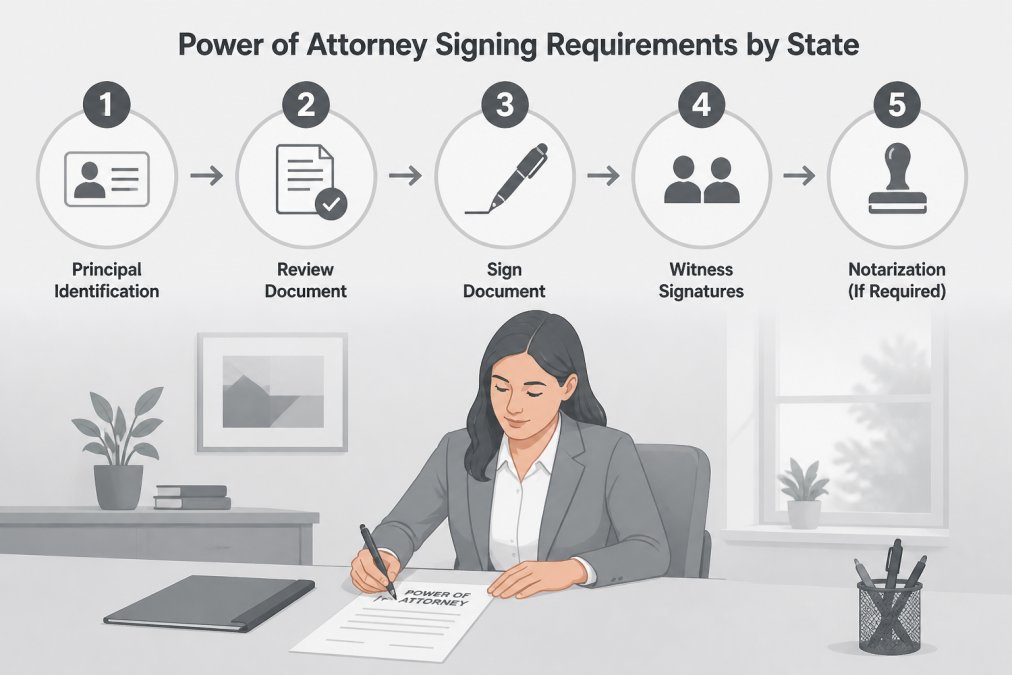
Power of Attorney Signing Requirements by State
Signature and Dating Rules
The signature requirement is universal: a power of attorney must be signed by the principal. But the specifics vary. Some states require the principal to sign in the presence of witnesses.
Dating the document is also required in most states, though a few states don't explicitly mandate it. The date matters because it establishes when the authority begins and helps resolve questions about the principal's mental capacity at the time of execution.
The key mistake professionals see: clients sign a power of attorney without understanding that the rules in their home state may not apply when they move or when their agent acts in a different state.
State-Specific Execution Variations
Some states have statutory forms for powers of attorney. Using the statutory form doesn't guarantee validity everywhere, but it does signal compliance with that state's requirements.
A handful of states have adopted the Uniform Power of Attorney Act (UPOAA), which standardizes certain rules and makes out-of-state documents more likely to be accepted. However, not all states follow the UPOAA, and even those that do may have unique requirements layered on top.
The practical reality: a power of attorney drafted for California might not work smoothly in Texas or Florida. The witness rules differ. The notarization rules differ. The language required to grant authority differs.
Power of Attorney Witness Requirements by State
Disinterested Witness Standards
Many states require that witnesses be "disinterested", meaning they have no financial stake in the principal's estate and aren't related to the principal or the agent. The reasoning is sound: disinterested witnesses are less likely to coerce or manipulate the principal into signing.
What counts as "interested"? Typically, a spouse, child, or beneficiary of the principal's will cannot serve as a witness. Neither can the agent themselves. Some states are stricter: they disqualify anyone who stands to gain from the principal's death, including creditors.
The challenge is that clients often want family members to witness the signing for convenience. In states with strict disinterested witness rules, this creates friction.
State Variations in Witness Rules
The number of required witnesses ranges from zero to three. Some states don't require witnesses at all if the document is notarized. Others require two witnesses in all cases.
Witness age also varies. Most states require witnesses to be at least 18. Some require them to be at least 21.
The timing of witness observation matters too. In some states, witnesses must see the principal sign. In others, the principal can sign first, then show the signed document to witnesses.
A white-glove estate planning service handles these details. The attorney assigned to the plan knows the rules in the client's state and ensures the document is executed correctly the first time.
Does a Power of Attorney Need to Be Notarized?
Notarization and Acknowledgment Across States
Notarization is required in some states, optional in others, and irrelevant in a few. The distinction matters because notarization adds a layer of verification: a notary public witnesses the signature and confirms the principal's identity.
States that require notarization typically do so for financial powers of attorney but not for healthcare powers of attorney. Some states require notarization only if the power of attorney grants authority over real property. Others require it for all powers of attorney.
Even in states where notarization is optional, many professionals recommend it because notarized documents are more likely to be accepted by banks and other institutions.
Impact on Document Acceptance
Banks, hospitals, and government agencies often have their own acceptance policies. Some institutions refuse to honor any power of attorney that isn't notarized, regardless of what state law requires. Others accept notarized documents more readily than unnotarized ones.
This creates a practical problem: a power of attorney that's technically valid under state law might be rejected by the institution where the agent needs to act.
A service that coordinates with clients and their agents can anticipate these issues and ensure the document is prepared in a way that institutions will accept.
Understanding Different Types of Power of Attorney
General, Limited, and Durable POAs
A general power of attorney grants broad authority to the agent. The principal authorizes the agent to handle financial matters, sign documents, and make decisions across many situations.
A limited power of attorney restricts the agent's authority to specific transactions or a defined period. For example, a principal might grant limited authority to sell a specific piece of real estate or to handle a particular business matter.
A durable power of attorney remains valid even if the principal becomes mentally incapacitated. This is the type most estate planning professionals focus on because it ensures continuity if the principal develops dementia or another condition that affects decision-making capacity.
Health Care and Financial Powers of Attorney
A financial power of attorney grants authority over money and property. The agent can pay bills, manage investments, buy and sell assets, and handle banking matters.
A health care power of attorney (also called a healthcare proxy or medical power of attorney) grants authority over medical decisions. The agent can consent to treatment, refuse treatment, and make end-of-life decisions on the principal's behalf.
Many states allow both powers of attorney to be combined in a single document. Others require separate documents. The rules vary, and the distinction matters because an agent's authority under a financial power of attorney doesn't automatically extend to healthcare decisions.
Power of Attorney Mistakes to Avoid
Common Execution Errors
The most frequent mistake is signing without witnesses when the state requires them. Clients often view the signing as a private matter and don't realize that state law mandates third-party observation.
Another common error is using the wrong form. Some states have statutory forms that carry a presumption of validity. Using a custom form or a form from another state creates unnecessary risk that an institution will reject the document.
Failing to notarize when it's required, or failing to notarize when it's optional but recommended, is also common. Clients who skip notarization to save a small fee often end up paying far more to fix problems later.
Choosing the Right Agent and Scope
Choosing the wrong agent is a mistake that happens before the document is even drafted. The agent should be someone the principal trusts completely and someone who is willing and able to serve. Family members are common choices, but they're not always the best choice.
Granting too much authority is another pitfall. Some clients authorize agents to make gifts or change beneficiaries on retirement accounts, creating opportunities for abuse or unintended consequences. Other clients authorize agents to make decisions that should require professional advice, like selling a business or restructuring a trust.
A professional who refers clients to an attorney-backed service ensures these decisions are made thoughtfully, with proper guidance.
Out-of-State Power of Attorney Documents
Reciprocal Recognition and Acceptance
Some states have reciprocal recognition agreements that honor powers of attorney from other states if they meet certain standards. However, reciprocal recognition is not automatic or universal. A power of attorney valid in New York might not be automatically accepted in Florida.
The safest approach is to assume that an out-of-state power of attorney may not be accepted without question. Banks, hospitals, and other institutions often have their own policies and may require additional documentation or clarification.
Many professionals recommend that clients who split time between states or who plan to move have powers of attorney executed in each state where they own property or might need to act. This eliminates ambiguity and prevents rejection.
When to Reexecute for a New State
If a client moves to a new state or acquires property in a new state, the question arises: does the old power of attorney still work?
Some states have adopted laws that recognize out-of-state powers of attorney if they were valid where executed. Others don't. The safest course is to have a new power of attorney executed under the laws of the new state, especially if the client owns real property there.
An attorney who understands multi-state planning can advise clients on whether reexecution is necessary and can draft documents that work across state lines.
Why Professional Guidance Matters
Estate planning laws are state-specific and change frequently. A power of attorney that was valid five years ago might not comply with current law. A document that works in one state might fail in another.
Financial advisors, insurance agents, and other professionals who refer clients to estate planning services are making a choice about the quality of experience their clients will receive.
When you refer a client to Nationwide Estate Planning Document Services for Financial Professionals or Nationwide Estate Planning Document Services for Insurance Agents, you're not just sending them to fill out a form.
Frequently Asked Questions
Does a power of attorney need to be notarized in every state?
No. Notarization requirements for power of attorney documents vary significantly by state. Some states require notarization for all POAs, while others require it only for specific types, such as durable powers of attorney or health care POAs. Some states allow POAs to be valid with only witness signatures and no notary involvement. Because requirements differ, it's critical to verify the specific rules in the state where the document will be used. Many financial institutions and hospitals prefer notarized documents regardless of state law, as notarization strengthens acceptance.
What are common power of attorney mistakes to avoid?
Common mistakes include failing to follow state-specific signing and witness requirements, which can render the document invalid; choosing an agent without clearly discussing their duties and limitations; creating a POA that is too broad or too narrow for the principal's actual needs; and not updating the document when circumstances change or when the principal relocates to a different state. Another frequent error is not providing copies to relevant institutions (banks, hospitals, employers) before they're needed, which can cause delays or rejection. Finally, many people create POAs without considering tax implications or coordination with other estate planning documents, which can create conflicts or gaps.
Can a power of attorney from one state be used in another state?
Many states recognize out-of-state POAs, especially if they comply with the law of the state where they were executed. However, acceptance is not guaranteed. Some institutions, particularly banks and hospitals, may be reluctant to accept an out-of-state document without verification. If a client has significant assets or ongoing obligations in multiple states, it may be safer to execute separate POAs complying with each state's requirements. Some professionals recommend obtaining a notarized certification of the document's validity in the original state if it will be used elsewhere. This is an area where state law varies considerably, so professional guidance is valuable.
What is the difference between a general power of attorney and a durable power of attorney?
A general power of attorney grants broad authority to the agent to act on behalf of the principal across many financial and legal matters. A durable power of attorney includes language that keeps the document effective even if the principal becomes mentally incapacitated. Without durability language, a standard POA typically becomes invalid if the principal loses mental capacity. Durability is often essential in estate planning because it ensures the agent can continue managing affairs if the principal develops cognitive decline. Many states have specific statutory language or forms required for durability, so understanding state requirements is important when drafting these documents.
Estate planning is too important to leave to chance. When your clients' financial security and their families' futures depend on a valid power of attorney, they deserve guidance from professionals who know the rules inside and out. Proven EP brings together attorney expertise, state-by-state knowledge, and a commitment to client experience, so you can refer with confidence, every time.